
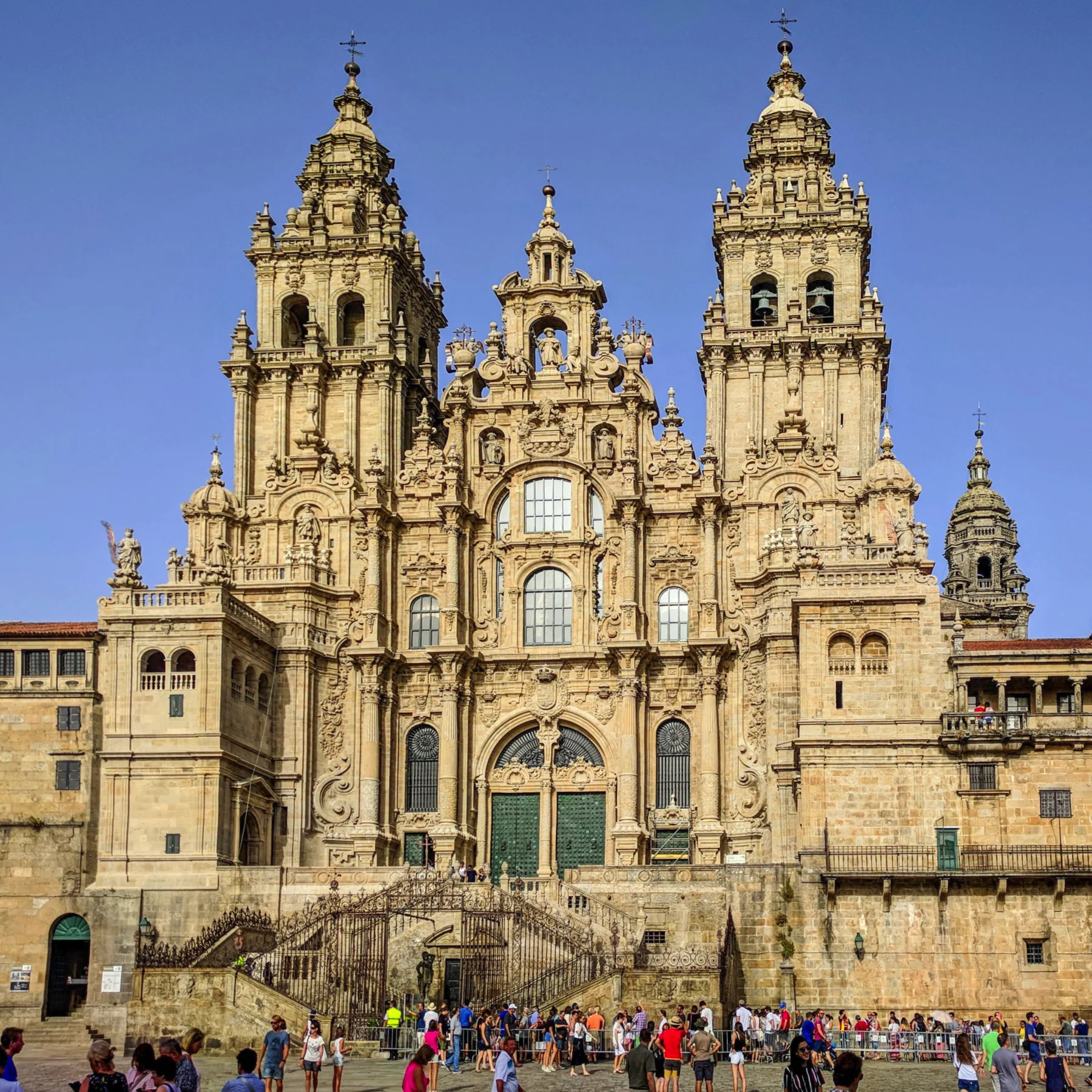
Spain · CATHOLIC PILGRIMAGE
Camino de Santiago Catholic pilgrimage guide
Faith, one footstep at a time.
WHY PILGRIMS COME HERE
The Camino is a network of pilgrim routes leading to Santiago de Compostela. It can be a sustained walking pilgrimage or a shorter visit to the cathedral city. The Compostela certificate requires at least the last 100 km on foot, most often walked from Sarria over 5–6 days. Choose the actual route and daily stages before deciding whether it matches your ability and intention.
Key facts
- Compostela requirements: at least the last 100 km on foot or horseback, or 200 km by bicycle, continuously, for religious or spiritual motives, with a stamped credential and two stamps per day in the last 100 km.
- Camino Francés: about 780 km from Saint-Jean-Pied-de-Port, typically 30–35 walking days; the common 100-km start is Sarria, about 115 km and 5–6 walking days.
- Camino Portugués: about 240 km from Porto (about 12 days); Tui (about 115 km) is the usual 100-km start. Camino Inglés from Ferrol: about 115 km.
- Typical daily stages: 20–25 km for experienced walkers; 12–18 km recommended for beginners or supported groups. Luggage transfer costs about €5–8 per bag per stage.
- Pilgrim Mass at Santiago Cathedral: daily, typically at noon and 7:30 p.m. Feast of St. James: July 25. The next Holy Year is 2027.
- Nearest airport: Santiago de Compostela (Lavacolla), about 10 km from the city; Galicia receives rain year-round.
WHY PILGRIMS COME HERE
Pilgrim information: Mass, confession, hours and dates
Times are local and published by the sanctuary; verified October 4, 2026. Schedules change for feasts and seasons — confirm before you go.
Cathedral of Santiago de Compostela
| Detail | Published information | Source |
|---|---|---|
| Cathedral opening hours | Every day 7:00 a.m.–9:00 p.m. (entrance: Porta de Praterías). | Source |
| Pilgrim's Masses (Main Altar) | Daily 7:30 a.m., 9:30 a.m., 12:00 noon, 7:30 p.m. | Source |
| English-language Mass | 10:30 a.m. daily except Wednesdays, Pilgrim's Office Chapel (Rúa Carretas 33). | Source |
| Other foreign-language Masses | English page: German 8:00 a.m. daily (San Fiz); French 9:00 a.m. (Pilgrim Reception chapel). Spanish page: German 9:00 Mon–Sat, 11:00 Sun (San Fructuoso); French 9:15; Polish 4:00 p.m.; Italian 4:30 p.m. (Santa María do Camiño). | Source |
| Confessions | In the ambulatory chapels (Santa Catalina, San Antonio, Virgen de la Soledad, San Juan, Salvador, Mondragón), in several languages. Hours are not published online. | Source |
| Adoration and Rosary | Chapel of the Blessed Sacrament: exposition 10:15 a.m.–7:00 p.m.; Holy Rosary 6:30 p.m. | Source |
| Botafumeiro status | "The Botafumeiro is temporarily not operating due to restoration work", as published on the cathedral's liturgy page. | Source |
| Botafumeiro feast days | Epiphany (6 Jan), Easter Sunday, Ascension, Apparition of St. James (23 May), Pentecost, Martyrdom of St. James (25 Jul), Assumption (15 Aug), All Saints (1 Nov), Christ the King, Immaculate Conception (8 Dec), Christmas, Translation of St. James (30 Dec). | Source |
| Botafumeiro group requests | Pilgrim groups may request it by email to botafumeiro@catedraldesantiago.es. The Spanish liturgy page gives a donation of €10 ("or the alms habitual in each country"); the English page gives no fee. | Source |
| Security rule | 'Access to the temple with backpacks is not allowed for security reasons.' | Source |
| Tomb of St. James and embrace of the Apostle | Inside the cathedral during opening hours (7:00 a.m.–9:00 p.m.); no separate hours are published on the visits page. | Source |
| Portico of Glory | Visited via the Cathedral Museum, daily 10:00 a.m.–8:00 p.m.; advance booking required (entradas.catedraldesantiago.es) and visitor numbers are limited for conservation. Prices are not on the information page. | Source |
| Museum, cloister, rooftops | Mon–Sun 10:00 a.m.–8:00 p.m.; booking at visitas.catedraldesantiago.es. | Source |
Pilgrim's Reception Office (Oficina del Peregrino), Santiago
| Detail | Published information | Source |
|---|---|---|
| Opening hours | Every day 9:00 a.m.–7:00 p.m.; closed 25 December and 1 January (the Compostela is then issued at the Cathedral). The FAQ page shows older seasonal hours; follow the main page. | Source |
| Queue system | Take a QR-code ticket to check the queue in real time. In times of great influx, same-day collection of the Compostela cannot be guaranteed. | Source |
| Compostela distance requirements | At least the last 100 km on foot or horseback (minimum 70 km within Spain if starting abroad), or the last 200 km by bicycle; continuous, ending at the Cathedral; stages allowed in chronological and geographical order. | Source |
| Compostela motive and credential | Granted to those who come for Christian reasons ("devotionis affectu, voti vel pietatis"), shown by a stamped Credencial del Peregrino. Children who understand the pilgrimage may receive it; younger children get a named certificate. | Source |
| Stamps per day | FAQ: at least 2 stamps per day in the last 100 km (foot/horse) or 200 km (bike); stamps at churches, hostels, hotels, town halls etc. | Source |
| Credencial | Issued by the Pilgrim's Office, parishes, dioceses, confraternities, authorised associations and hostels, for pilgrims on foot, bicycle or horseback with Christian intent; a digital credential app exists. Cost not published. | Source |
| Certificate of Distance | €3; issued by the Cathedral Chapter stating start point, kilometres, arrival date and route; may also be requested by past pilgrims (certificadodedistancia@catedraldesantiago.es). | Source |
Key dates
| Date | What happens | Source |
|---|---|---|
| July 25 | Solemnity of St. James (Martyrdom); Botafumeiro feast day | Source |
| May 23 | Apparition of St. James (Clavijo); Botafumeiro feast day | Source |
| December 30 | Translation of the relics of St. James; Botafumeiro feast day | Source |
| Holy Year 2027 | Compostelan Holy Year 2027, motto "Al ver la estrella, se llenaron de inmensa alegría" (Mt 2:10), with a pastoral letter by Archbishop Francisco Prieto. The Holy Door opening date is not yet published. | Source |
| December 31, 2026 (eve of the Holy Year) | Holy Door opening ceremony; for the last Holy Year it took place on 31 December from 4:30 p.m. Confirm the 2026 ceremony at catedraldesantiago.es. | Source |
Sacred places to discover
Santiago Cathedral
The goal of the pilgrimage to the tomb of St. James; Pilgrim Mass daily at about noon and 7:30 p.m., with the botafumeiro swung only on certain feasts or when arranged by a group.
The Camino Francés
The best-known route, about 780 km across northern Spain from Saint-Jean-Pied-de-Port; most pilgrims walk its final 115 km from Sarria.
The Camino Portugués
About 240 km from Porto through Portugal and Galicia, with Tui as the usual 100-km start.
Galician villages
Small churches and communities along the final stages, where the credential collects its two stamps a day.
Make the journey your own
- Walk with a personal prayer intention
- Keep a pilgrim credential stamped along the way
- Finish with the Pilgrim Mass and time for thanksgiving
When to go
May–June and September are generally considered the best walking months. July and August are the busiest, and July 25 (the Feast of St. James) brings the largest crowds to the city. Galicia can be wet even when the journey begins in warm weather; rain is common year-round.
Walking & practical expectations
Repeated walking days require preparation. Beginners and supported groups should plan 12–18 km per day; experienced walkers manage 20–25 km. A short section can still be physically demanding: the Sarria stages include long climbs and descents on rural paths. Luggage transfer (about €5–8 per bag per stage) removes the pack but not the distance.
Suggested pacing is planning guidance. Specific access, liturgies, and services require confirmation.
Planning this pilgrimage
Planning overview
Start with the route, your ability, and the number of days you can realistically walk. The Camino is not one fixed itinerary. A supported short section, an independent long route, and a pilgrimage visit to Santiago are different choices with different demands. The most common first Camino is the final 115 km of the Camino Francés from Sarria, walked in 5–6 days.
Choose actual stages
Look at each day's distance, terrain, and lodging options. Experienced walkers typically cover 20–25 km a day; beginners and supported groups should plan 12–18 km. The full Camino Francés is about 780 km from Saint-Jean-Pied-de-Port (30–35 walking days); the Camino Portugués from Porto is about 240 km (about 12 days), with Tui (about 115 km) as its usual 100-km start; the Camino Inglés from Ferrol is about 115 km. Consecutive days make a difference even when no single day seems unusually long. Plan rest and understand what happens if you need transport or cannot complete a stage. May–June and September are generally the best walking months; July–August is busiest, and Galicia is rainy in every season.
Decide what support matters
Luggage transport, private rooms, booked meals, and a guide can simplify parts of the journey but need explicit confirmation. Luggage transfer services such as Correos "Paq Mochila" or Jacotrans cost about €5–8 per bag per stage on the main routes. Independent walking offers flexibility while placing more decisions on you. Choose the level of support that suits your experience.
Check certificate rules separately
A meaningful pilgrimage does not depend on a certificate. The Compostela requires at least the last 100 km on foot or horseback (200 km by bicycle), walked continuously for religious or spiritual motives, recorded in a stamped credential with two stamps per day in the last 100 km; non-religious walkers receive a "certificado" instead. The credential is issued by the Pilgrim Office, confraternities, parishes, and many albergues for a few euros. Verify the route and documentation with the Cathedral's Pilgrim Office before booking. In Santiago, the Pilgrim Mass is celebrated daily, typically at noon and 7:30 p.m.; the botafumeiro swings only on certain feasts or when arranged by a group. Do not let a certificate goal override a sensible decision about fatigue, weather, or your ability to continue.
Traveling with your priest? Find his pilgrimage.
Official sources cover institutional information. Suggested pacing and itinerary choices are planning guidance. Check current arrangements for your travel dates.
KNOW BEFORE YOU GO
Your questions, answered.
What is the Camino de Santiago?
Santiago & the CaminoDo I have to walk the whole Camino?
Santiago & the CaminoWhat is the Compostela certificate?
Santiago & the CaminoWhat is a pilgrim credential on the Camino?
Santiago & the CaminoHow far must I walk to qualify for the Compostela?
Santiago & the CaminoIs the Camino suitable for a beginner?
Santiago & the CaminoCan I have my luggage transported on the Camino?
Santiago & the CaminoDo I need to stay in shared hostels on the Camino?
Santiago & the CaminoWhat is the 2027 Compostela Holy Year?
Santiago & the CaminoHow much does it cost to walk the Camino de Santiago?
Santiago & the CaminoHow difficult is the Camino from Sarria to Santiago?
Santiago & the CaminoWhich Camino route can I complete in one week?
Santiago & the CaminoWhat time is the Pilgrim’s Mass in Santiago de Compostela, and when does the Botafumeiro swing?
Santiago & the CaminoHow should I train for the Camino de Santiago?
Santiago & the CaminoIs it safe to walk the Camino alone?
Santiago & the CaminoWhat is the best month to walk the Camino?
Santiago & the CaminoCan I cycle the Camino instead of walking?
Santiago & the CaminoCamino de Santiago routes: an overview of the Francés, Portugués, Norte, Primitivo, and Inglés with distances in miles and days
Santiago & the CaminoHow long is the Camino de Santiago in miles and days?
Santiago & the CaminoSarria to Santiago in 5 or 7 days: stages, miles, and difficulty
Santiago & the CaminoCamino de Santiago packing list for men and women, by season
Santiago & the CaminoIs the Camino hard, safe, and Catholic, and is it worth it?
Santiago & the CaminoCompostela certificate requirements and online registration at the Pilgrim's Office
EVERY PILGRIMAGE BEGINS WITH A FIRST STEP
Where is your faith
calling you?
Tell us what you have in mind. A place, a prayer intention, a parish, or simply a desire to go.
Start planning