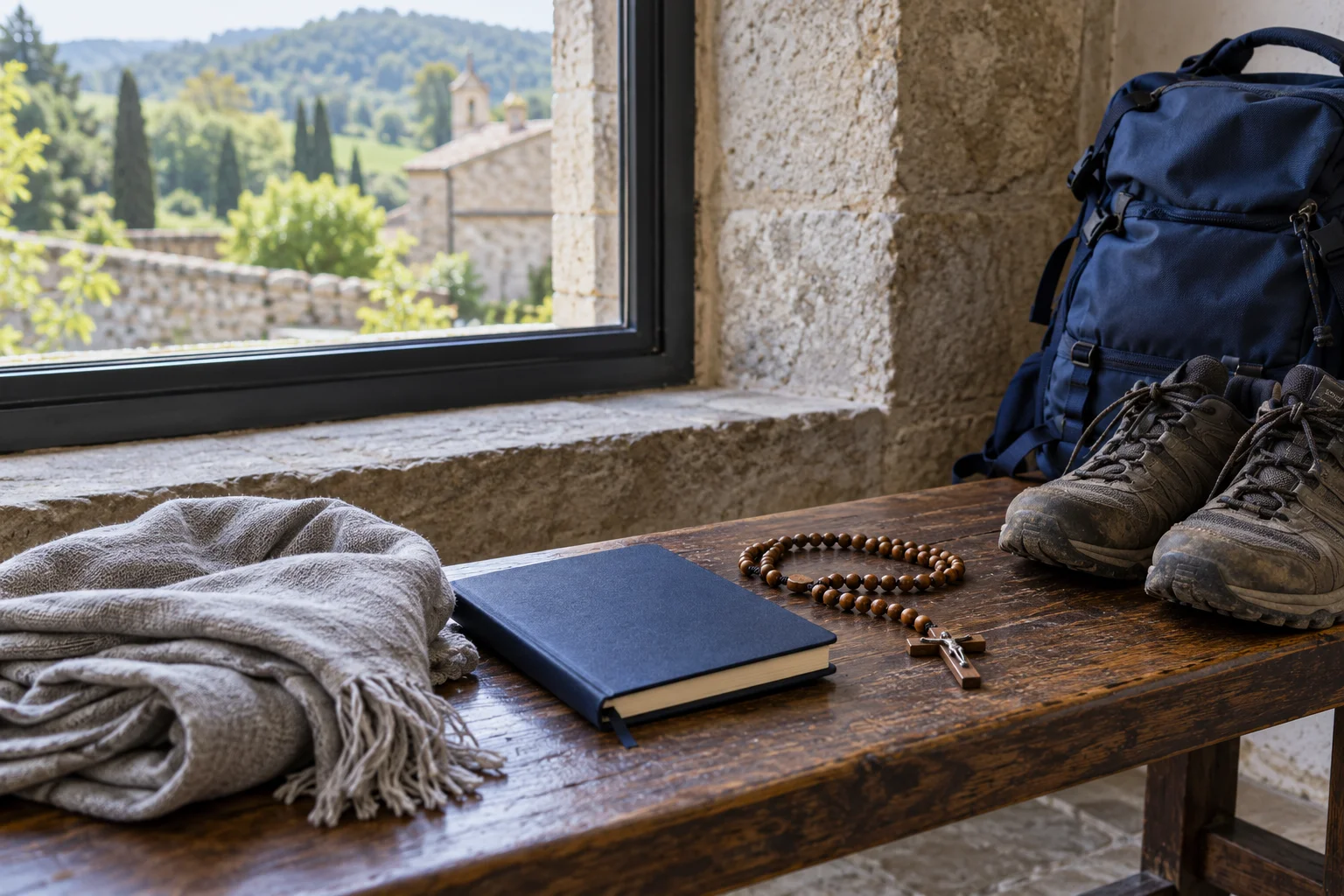
Pack for the actual route, not for an imagined perfect trip. Your bag should support comfortable walking, respectful church visits, and the weather you may encounter. Begin with essentials and then test whether you can manage the luggage through a transfer yourself.
Clothing and footwear
Choose familiar walking shoes and layers that work together. Include clothing that meets the strictest dress requirements on your route so a church visit does not depend on improvising at the entrance: at St. Peter's and the Vatican Museums that means shoulders covered, no shorts above the knee, no miniskirts, and no hats inside, and the same standard applies at most shrines. Pack for the specific conditions: catacombs stay at about 15 °C underground, Galicia is rainy year-round, and Mexico City nights are cool from November to February. Think about laundry access before adding a separate outfit for every day.
The day bag
Keep the items you regularly need accessible: travel information, water where permitted, a small layer, and any essential personal items. Avoid carrying all your valuables or your entire trip budget in one easy-to-lose place; €40–70 per day covers excluded meals and incidentals in Western Europe. Check site rules for large bags before a visit; the Vatican Museums and St. Peter's screen all bags at security.
Before closing the suitcase
Confirm every carrier's baggage allowance, including regional flights. If you plan to bring home Lourdes water, the 100 ml carry-on liquid limit applies, so pack bottles in checked baggage. Check plugs and device compatibility rather than assuming an adapter changes voltage. Keep copies of important documents separately and leave room for a small purchase. A lighter bag makes repeated hotel moves less demanding, and on the Camino a luggage transfer service costs about €5–8 per bag per stage.
What should I pack for a Catholic pilgrimage?
Pack comfortable walking shoes, clothing that covers shoulders and knees for churches, weather layers, travel documents, and a small day bag. Add a prayer book or rosary if useful. Shoulders and knees covered is the standard at St. Peter’s, the Vatican Museums, and most shrines; hats are removed inside St. Peter’s. If you plan to bring home Lourdes water, the carry-on liquid limit is 100 ml per container, so larger bottles go in checked baggage.
Base the rest on destination, season, laundry access, and the baggage allowance for every flight. A lighter bag is easier through airports, old hotels, and transfers; keep essential personal items within easy reach.
Related questions, answered
How do I wash clothes on the Camino?
Most Camino albergues provide a laundry sink with drying lines, and many also have a coin-operated washer and dryer, commonly a few euros per load; a small bottle of travel detergent, a universal sink plug, and safety pins or a short cord for drying on the pack are the only supplies needed. Wash the day's clothes on arrival so they dry overnight, and carry two sets of quick-dry walking clothes rather than more. Merino socks dry slowly and should be hung first. In Galicia, where rain is common year-round, finish drying damp items pinned to the outside of the pack the next morning.
Source: Cathedral's Pilgrim Office: the credential
What plug adapters will I need for a pilgrimage?
For Italy, France, Spain, Portugal, Poland, Bosnia and Herzegovina, and Croatia, pack a Type C or Type F (two round pin) adapter; Italy also uses the three-pin Type L, which Type C fits. Ireland uses the three-pin Type G plug, Israel the Type H (Type C fits most Israeli sockets), and Mexico the same Type A and B plugs as the United States, so no adapter is needed there. European and Israeli mains are 230 volts, 50 Hz; phone, camera, and laptop chargers are dual voltage, but older hair dryers and curling irons are not and need a converter or should stay home.
Can I bring prescription medication on an international pilgrimage?
Yes, prescription medication may be carried on international flights: TSA permits pills in any quantity and allows medically necessary liquids above 3.4 ounces if they are declared at the checkpoint. Pack all medication in carry-on luggage in the original labeled containers, bring enough for the whole trip plus several days of delay, and carry copies of each prescription with the generic drug names, as the CDC advises. For controlled or injectable medicines, add a letter from the prescriber. Check the destination country's rules through its embassy before travel; many countries accept a 30-day personal supply with a prescription but restrict some stimulants and strong painkillers.
Source: CDC: traveling abroad with medicine