
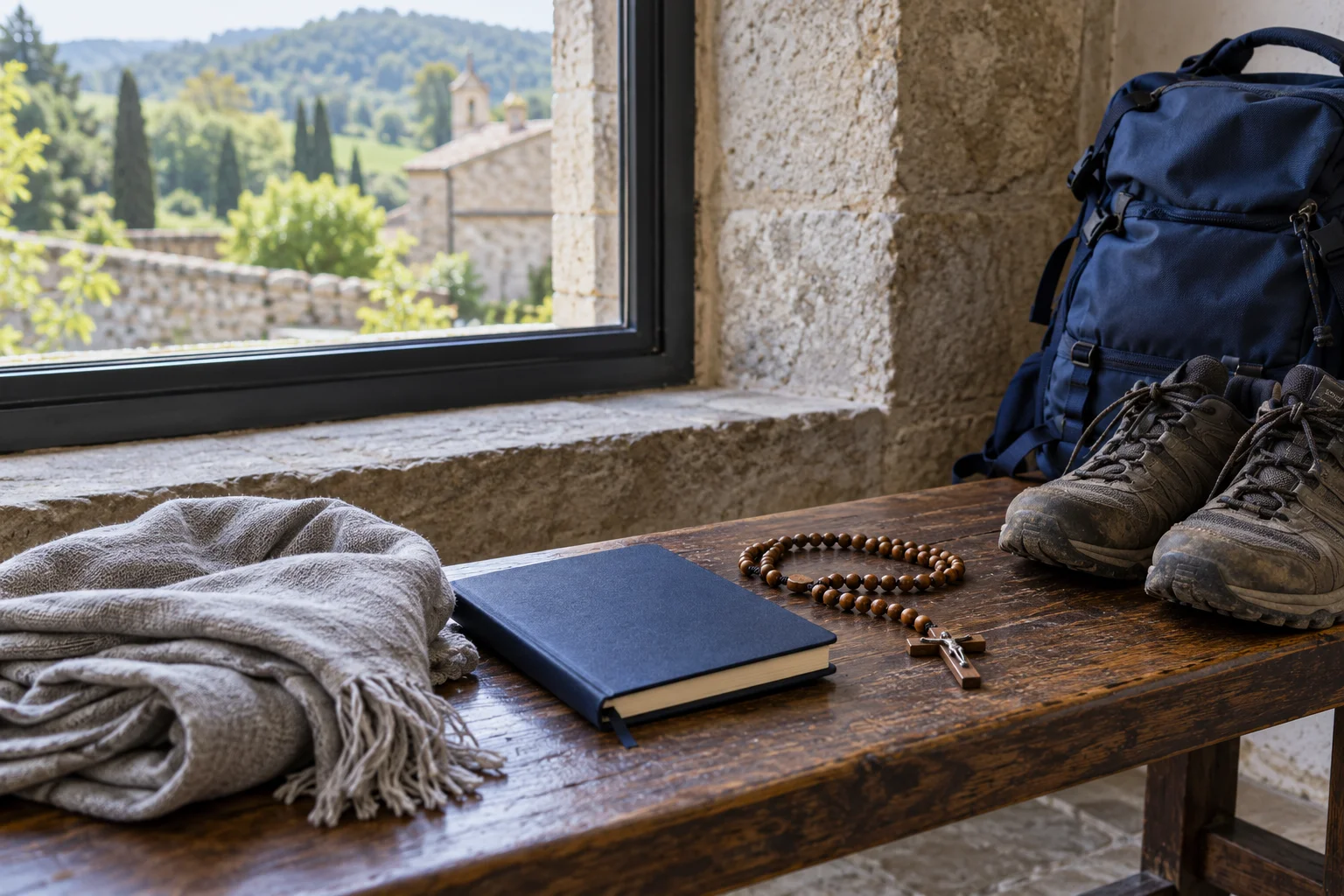
Choose the spiritual center
Rome offers the breadth of the Church's history, with four papal basilicas and the catacombs. Assisi narrows the focus to Francis and Clare in a hill town of about 400 m elevation. Lourdes (apparitions of 1858) and Fátima (1917) offer different Marian traditions, while the Camino makes sustained walking part of the experience, with the Compostela requiring at least the last 100 km on foot. Resist ranking them as if one were universally more spiritual. Ask which setting will help you pray and pay attention.
Three travelers, three different choices
A couple giving thanks after a difficult year may prefer several nights at one shrine, shared meals, and an evening they can spend alone; Lourdes and Fátima both reward a stay of two or three full days. Someone newly interested in Catholic history may want Rome with careful guiding and time to revisit a basilica. A parish hoping to grow closer may value a common prayer rhythm and a single hotel more than adding another country; Medjugorje's parish program, with evening prayer at 6:00 p.m. in summer, is built for exactly that.
The destination serves the people and their purpose. Start with the experience you need before choosing the longest route.
Read the days, not the headline
A destination list can hide long transfers and repeated hotel changes. Read each day from breakfast to the return to the hotel. Identify the longest walk, the earliest start, and the busiest transfer. Typical pilgrimage groups in Rome walk 8–12 km per day, while operators commonly label 5–8 km as "moderate." Check whether free time remains genuinely free or is filled with paid options.
Use your hardest day as the test
Look for the day with the most walking or the longest transfer. Imagine doing it after several nights away from home, with the same shoes and luggage you will bring. Ask what changes if you need a slower morning or cannot join the afternoon climb. Averages can hide the day that makes the itinerary unsuitable.
For a family, the deciding issue may be late meals and room arrangements. For a solo traveler, it may be the single supplement, commonly $600–$1,200 on a 9–10 day European pilgrimage, and how free time works. Name the detail that could make you uncomfortable and resolve it before booking.
Make the final comparison
Compare the total cost, the room arrangement, the practical support, and the confidence you have in the written information. A 9–10 day air-inclusive Rome and Assisi or Fátima and Lourdes pilgrimage from the U.S. commonly costs $4,000–$6,000 per person in a shared room. Ask which services are confirmed and which are proposed. If an itinerary requires you to ignore a serious concern about mobility or cost, keep looking. A well-matched journey begins with an honest decision.
What is a saint-focused pilgrimage?
A saint-focused pilgrimage follows places connected with a saint’s life, ministry, burial, or enduring devotional legacy. Assisi for Francis and Clare is the clearest example: the tomb of St. Francis lies in the crypt beneath the Lower Church of his basilica, the San Damiano Crucifix and the tomb of St. Clare are in the Basilica of St. Clare, and the feasts fall on October 4 (Francis) and August 11 (Clare). Poland offers a second model: St. Faustina’s tomb at the Divine Mercy Sanctuary in Kraków-Łagiewniki (feast October 5) and St. John Paul II’s birthplace at Wadowice, about 50 km from Kraków (feast October 22).
Choose a route with enough time to understand the person, not simply photograph several churches bearing their name. Reading a short biography beforehand adds context and helps distinguish documented events from later traditions.
How do I choose my first Catholic pilgrimage?
Choose the spiritual focus first, then assess pace, cost, and travel complexity. For most first-time pilgrims the three realistic shapes are a 9–10 day Rome and Assisi journey (commonly $4,000–$6,000 air-inclusive from the U.S.), a shrine stay such as Lourdes or Fátima with a more settled rhythm, or a walking route such as the last 115 km of the Camino from Sarria in 5–6 days. Rome suits interest in the Apostles and the wider Church and needs four or five full days on its own.
Compare one actual daily itinerary from each option, and begin 4–8 months ahead for an individual booking.
Is it better to visit one shrine or several?
One shrine is better for prayer and rest; several are better for breadth. A single base such as Lourdes gives a repeating daily rhythm (Eucharistic procession about 5:00 p.m., torchlight procession about 9:00 p.m., in season from Easter to the end of October) and no repacking. Several destinations provide a broader experience but require transfers and repeated settling in; Lourdes to Fátima, for example, is roughly 900 km and consumes most of a day.
Choose according to the purpose of the journey rather than the length of the attraction list. If you are accompanying someone who needs rest or assistance, fewer bases can simplify daily life. A short route can still be spiritually rich.